Ice Hockey Betting: A Proof-Driven Guide for UK Punters
Proof-driven hockey betting for UK punters
 Available in US
The first hockey bet I lost real money on was a Toronto Maple Leafs moneyline at 1.62. They were at home, they were the better side on paper, and their starter scratched twenty minutes before puck drop. The backup let in four on the first thirteen shots. I walked away from that night with two convictions that have shaped nine years of work in this market: hockey rewards the bettor who reads the line behind the line, and most published guides do not bother to tell you what is actually moving the price.
This guide is for the UK punter who wants to bet on ice hockey with the same rigour they would apply to a football accumulator or a horse-racing handicap. Not promo copy dressed as advice. Not generic moneyline explainers recycled across a hundred operator pages. The premise is straightforward — if a claim cannot be backed by a number, a regulator, a league report, or a working bettor I respect, it does not belong here. The UK market is its own beast: regulated by the Gambling Commission, dominated by football, but with a quietly maturing hockey scene at home in the Elite League and a vast nightly menu of North American matches landing on UK evening hours.
Across these sections you will find the cash flow of the regulated UK market, the architecture of the NHL and EIHL seasons, the maths of puck lines and totals, the strategy frameworks I use to filter games, the international windows that matter, and the safer-gambling tools every UK bettor should know by name. Pull up a chair.
Before the deep work, the headline takeaways — for anyone who wants the gist before the detail.
Table of Contents
- What to Hold Onto From This Guide
- How Big Is the UK Hockey Betting Pond, Really?
- Two Leagues, Two Betting Personalities
- The Markets You Will Actually Use
- Decimal Odds, Implied Probability, and the Hold You Are Paying
- Who Is Actually Betting on Hockey in Britain
- What Edges Actually Look Like in Hockey
- Where the Money Actually Moves — Live versus Pre-Match
- The International Calendar That UK Books Quietly Price
- The Criteria That Actually Matter When You Pick Where to Bet
- The Safer-Gambling Toolkit Every UK Hockey Punter Should Know
- The Hockey Year From a UK Punter’s Desk
- Where to Go From Here
- Frequently Asked Questions
What to Hold Onto From This Guide
- The UK regulated remote gambling sector turned over £7.8 billion in 2024/25, with £2.6 billion of that landing in online sports betting — hockey is a small but rising slice of that pie.
- The EIHL is in a genuine boom: 1,321,128 spectators across 2025/26, four straight seasons of attendance growth, and ten clubs feeding a 270-match regular season UK punters can bet on at home time.
- The NHL gives you 1,271 regulated games from October to April, and a confirmed starting goaltender can move a moneyline by three to five percentage points of implied probability before the public catches up.
- Live ice hockey betting now drives more than sixty percent of regulated hockey volume in mature markets — but it is also where untrained bankrolls bleed fastest.
- Every serious UK hockey bettor should have GAMSTOP, deposit limits and a unit-staking plan in place before the first puck drops in October.
How Big Is the UK Hockey Betting Pond, Really?
People who only watch football tend to assume hockey betting in the UK is a rounding error. They are right about the proportion and wrong about the rate of change. The total Gross Gambling Yield from the regulated remote sector — casino, betting and bingo combined — hit £7.8 billion in the financial year running April 2024 through March 2025, a 13.1 percent jump on the year before. Of that pile, £2.6 billion was specifically online sports betting. Football took roughly half, horse racing claimed £766.7 million, and everything else — tennis, cricket, basketball, hockey, darts, esports, niche markets — split the rest. Hockey is in the long tail of “everything else”, but the tail itself is fatter than it has ever been.

What “online sports betting GGY” actually means
Gross Gambling Yield is the amount kept by operators after paying winnings — your losses, in other words, before tax and overheads. When you see £2.6 billion across UK online sports betting, that is the figure punters collectively left with the books in a year.
Why does the broader market matter for a hockey punter? Two reasons. First, market size dictates how much pricing attention operators give a sport. Football lines tighten because the volume forces sharpness; hockey lines, especially on European leagues, leak more juice and move more dramatically on small information. Second, regulatory pressure scales with size — the Gambling Commission’s tools, GAMSTOP integration, deposit-limit defaults, advertising standards — apply to the £7.8 billion pot, and that protection extends to your EIHL singles just as it does to your Premier League accumulators.
Look at participation and the picture sharpens. The third wave of the Gambling Survey for Great Britain, covering July through October 2025, found 39 percent of UK adults had gambled online in the past month — drop the National Lottery and that figure becomes 16 percent. Eight percent had specifically placed an online sports bet. Roughly 47 percent of British adults aged sixteen and over participated in some form of gambling in 2025, with men making sports bets at nearly four times the rate of women.
The mobile shift — 95 percent of UK online gambling now happens at home, and 76 percent of 18 to 24-year-old bettors place those bets on a mobile device. The puck-drop-to-bet-confirmation window has collapsed to seconds.
For hockey specifically, that mobile-first reality changes the betting clock. NHL games begin at 11 pm or 1 am UK time. A laptop-bound punter from 2010 would have been asleep. The current generation sets a goalie-confirmation alert, opens a sportsbook app from the sofa, and locks the puck line during the warm-up skate. Volumes are not yet football-sized. But the infrastructure is there, the regulation is solid, and the appetite is climbing visibly in EIHL arenas that did not used to sell out.
Two Leagues, Two Betting Personalities
Ask a UK hockey punter where they bet most and you will get one of two answers. The traveller — usually older, usually a fan of a Belfast, Sheffield, Cardiff or Nottingham side — will tell you Elite League first, NHL when nothing else is on. The data analyst — usually younger, often a recent convert from football modelling — will tell you NHL nightly, EIHL never. Both are right for their own reasons, and both are missing what the other one sees.

The NHL is the deepest, most-priced hockey market in the world. Thirty-two clubs, eighty-two regular-season matches each, a total of 1,271 fixtures from October through to mid-April, and then a two-month playoff that is the most volatile betting environment in any sport I cover. UK books offer the full NHL menu — moneylines, puck lines, totals, anytime goalscorers, period winners, futures, props, you name it. Margins are tighter, the information environment is mature, and the kind of edges I look for tend to come from goalie news, schedule fatigue and live in-game spots rather than season-long handicapping.
The EIHL is a different animal. Ten teams from England, Scotland, Wales and Northern Ireland skating a 270-match regular season, then a Challenge Cup, a regular-season championship and a Playoff Finals Weekend that has now become an event in its own right. The 2025/26 season set a competition-wide record — 1,321,128 total spectators, a 3,863 average per game, and half the league pulling more than 3,000 fans through the turnstiles on a typical night. Four straight seasons of growth. The Challenge Cup Final and Playoff Finals Weekend both sold out in 2025/26. That is genuine commercial momentum, and it is starting to show in the market depth UK books offer on the league.
| Dimension | NHL betting from the UK | EIHL betting from the UK |
|---|---|---|
| Volume of regular-season fixtures | 1,271 games, October to April | 270 games, September to April |
| UK kick-off times | Mostly 11 pm to 4 am local time | Weekend evenings and Sunday afternoons |
| Market depth at UK sportsbooks | Deep: moneyline, puck line, totals, props, futures, SGP | Moderate: moneyline, totals, often handicap; thinner props |
| Information environment | Mature, fast, broad analyst community | Less efficient, fewer eyes on lines |
| Typical line movement triggers | Goalie news, trade deadline, injuries | Imports availability, weekend back-to-backs, arena form |
The biggest practical difference: NHL lines are sharp by the time they hit the UK market, because they have already been shaped by professional money in North America. EIHL lines are quieter. There is less professional action, fewer analytical eyes, and that means more pricing inefficiency for a UK punter who watches the league closely. The trade-off is information access — EIHL injury news, line combinations and goalie rotations are harder to find than NHL equivalents, and you will end up doing your own legwork.
NHL fixture density
Roughly ten to fourteen games per night during the regular season, peaking on Saturdays.
EIHL fixture density
Three to five games on a typical Saturday and Sunday during the season.
Playoff windows
NHL playoffs: April to mid-June. EIHL Playoff Finals Weekend: usually mid-April.
Most UK punters I work with end up bilingual — NHL for nightly volume, EIHL for value plays and weekend variance. If you want the deeper league-specific work, I have written a full NHL betting guide for UK punters and a dedicated EIHL betting deep dive that pick up exactly where this section stops.
The Markets You Will Actually Use
Hockey markets look intimidating until you realise the entire menu is built from three anchor bets and a dozen variations on them. Moneyline, puck line, totals. Everything else — props, periods, SGPs, futures — is a rearrangement of those three ideas. Once that lands, the rest of the menu becomes a question of pricing rather than concept.
The three anchors
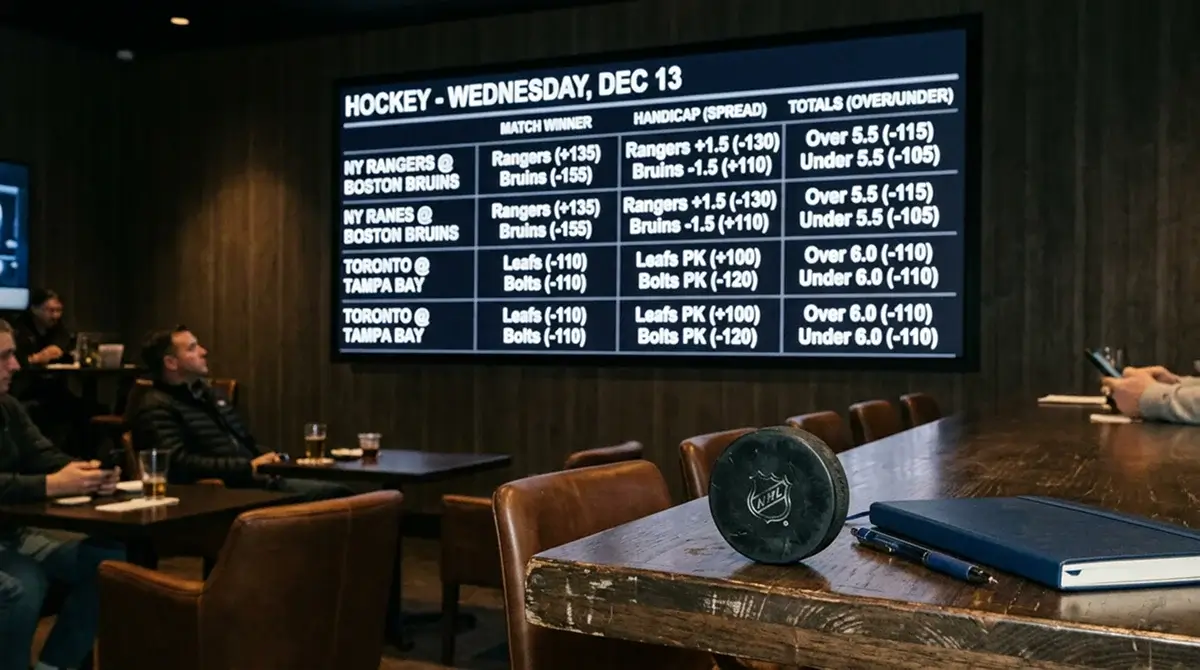
Moneyline picks the winner outright. Puck line is the hockey version of a handicap — usually 1.5 goals — so you can back a heavy favourite at a longer price (if they win by two or more) or a struggling side at a shorter price (if they lose by one, or win). Totals ask whether the combined goal count will land over or under a posted number, almost always 5.5 or 6.0 in the NHL.
The variations are where most punters get tripped up. Three-way moneyline removes the overtime rule and prices a draw at the end of regulation as its own outcome. Period winners ask which team scores more in a specific twenty-minute segment. Anytime goalscorer lists every skater on the team sheet with an individual price. Same-game parlay bundles several of those into one ticket with correlation-adjusted maths. NHL futures price the Stanley Cup, the conference winner, individual awards. The thing they all share: you should be able to write a one-sentence rationale before you stake anything. If you cannot, you are gambling, not betting.
| Market | Sample line (illustrative) | What you are saying |
|---|---|---|
| Moneyline — home | 1.83 | Home team wins in regulation, overtime, or shootout. |
| Puck line — away +1.5 | 1.72 | Away team loses by exactly one, or wins outright. |
| Total — over 6.0 | 1.95 | Combined goals exceed six. Exactly six is a push. |
| Three-way ML — regulation tie | 3.90 | Game is tied at the end of sixty minutes. |
| Anytime goalscorer — top-line winger | 2.40 | Named player scores at least one goal in any situation. |
The single biggest hidden factor across all of these is the starting goaltender. Caesars’ head of hockey, Karry Shreeve, has stated the standard estimate publicly: replacing the starter typically moves the implied probability on a moneyline by three to five percentage points. That is the difference between a -110 favourite and a near-coin-flip line on the same fixture. Books bake in goalie information once it is confirmed. Bettors who lock prices before confirmation are either getting paid for the risk or punished for the guess. There is no third option.
I am going to be brief here because the proper market-by-market work lives in the dedicated guide — moneyline maths, puck-line nuances, totals research, props strategy, SGPs, period markets and the rest. If you want it broken out fully with worked examples for each bet, the ice hockey bet types deep dive takes you through every market on the UK menu.
Decimal Odds, Implied Probability, and the Hold You Are Paying
Most UK punters glance at decimal odds, take the payout figure as gospel and never reverse-engineer the implied probability. That is leaving information on the table. The price tells you everything about what the book thinks — and, equally, what the book is charging you to take a position.

Implied probability — divide one by the decimal price, then multiply by 100, to get the percentage chance the book is pricing into the line.
The mechanics are simple. A 2.00 price implies a 50 percent chance. A 1.50 price implies 66.7 percent. A 4.00 price implies 25 percent. Add the implied probabilities of both sides of a two-way market and you will always land above 100 — the excess is the hold, also called the juice, the vig, or the overround depending on who is talking. In a regulated US sports betting context, the average operator hold across 2025 settled around 10.15 percent of the $165.58 billion handle, and live in-play wagering accounted for more than sixty percent of total volume. UK books run slightly tighter on the headline markets and looser on the props and exotics — that is where their margin comes from.
Walking through a typical NHL two-way moneyline
Home team priced at 1.83. Away team priced at 2.10. Convert each to implied probability: 1 divided by 1.83 equals 0.5464 — so 54.6 percent. 1 divided by 2.10 equals 0.4762 — so 47.6 percent.
Add them: 54.6 plus 47.6 equals 102.2. The hold is 2.2 percentage points on the headline market — relatively sharp by UK book standards. A wider book on the same fixture might price 1.78 and 2.00, which produces a hold closer to 6 percent.
The no-vig fair price — what the book “really” thinks — is your implied probability divided by the total. 54.6 divided by 102.2 equals 53.4 percent fair for the home side. That is the number to beat with your own model.
The discipline this exercise builds is what separates a punter with edge from one without. If you cannot tell me what the no-vig fair price is on a market you are about to take, you do not know whether you are getting value. You are just trusting the gut and paying the hold.
Who Is Actually Betting on Hockey in Britain
I get asked the demographic question more than any other. “Is hockey betting in the UK growing because new people are arriving, or because existing punters are diversifying?” The honest answer is both, in different proportions depending on the league. The data on UK gambling participation tells you who is exposed, and the NHL audience profile in North America tells you what the global product looks like to the people building UK pricing models.

The most exposed UK age cohort
21.9 percent of 18 to 24-year-olds in Britain have a PGSI score of 1 or higher — meaning some indicator of problem-related behaviour — and 5.3 percent score 8 or higher, the threshold for serious harm. The single most concentrated risk band in the country.
Hockey’s broader media context
Eleven Premier League clubs entered the 2025/26 season with gambling brand sponsorship. The voluntary ban on front-of-shirt gambling sponsorship lands at the end of that season. UK punters consume hockey inside an advertising environment that is mid-shift.
The NHL fan profile globally
NHL audience reach has held at 17 percent of internet-connected US adults for three consecutive years. 45 percent of NHL fans are aged 55 or older, and 63 percent are men. The product is stable but skews older than the UK punter touching it.
The cohort mismatch — UK NHL bettors I work with skew significantly younger than NHL fans in North America. The under-35 share of UK hockey punters is rising fastest, but it is also the most behaviourally vulnerable group. That tension is the single most important context for the safer-gambling section later in this guide.
What does the cohort mismatch mean in practice? It means UK pricing for NHL markets is influenced by demand from a younger, more mobile, more in-play-driven punter base than the people actually watching the games in person in Toronto or Tampa. Live markets behave that way for a reason. Props skew towards stars who travel well on UK socials. And it means the responsible-gambling tools we will get to in a few sections matter more here than the casual framing of “just a flutter” implies. A twenty-two-year-old watching a Maple Leafs game at 3 am on his phone is in a fundamentally different risk environment to a fifty-eight-year-old season ticket holder in Detroit.
What Edges Actually Look Like in Hockey
I run a notebook of every NHL bet I make and the reason for it. Nine years in, the pattern is consistent — the bets that win long-term cluster around four or five repeatable signals, and the bets that bleed are almost always built on narrative rather than number. Kyle Kargel, who handicaps the NHL for StatsAlt, put it cleanly: “Winning in hockey requires more than just knowing who’s hot or who won their last game. The NHL is a high-variance league where small edges, timing, and context often matter more than raw talent.” That is exactly the position I argue from.

The Covers editorial team — twenty-five-plus years on this market — put the upside in a single line: “Hockey betting isn’t as popular as some of the other major sports, but the edges on the ice are limitless, with a plethora of ways to get in on the action.” I read that as both an invitation and a warning. The edges exist because the market is thinner. The market is thinner because fewer professionals are pricing it. Fewer professionals means more variance for the punter who shows up without a process.
Tip — the goaltender sample size problem
A goaltender’s save percentage stabilises after roughly 1,500 to 2,000 shots faced. That is most of a full season of starts. Anything you read in October, November or early December is statistical noise. The bettor who chases hot Sv% in week three is paying a tax to the bettor who waits for the sample to land.
The repeatable signals that have paid me over the long run: confirmed goalie news ahead of consensus pricing, second-night-of-back-to-back fatigue with road travel, regression candidates against possession metrics, and live-market overreactions to single-event variance — a fluke goal in the opening minutes that swings the moneyline more than the underlying probabilities justify. None of these is exotic. All of them require process.
Before any hockey stake — the five-question filter
- Is the starting goaltender confirmed by the team, or am I guessing from a projected lineup?
- Is either side on the second half of a back-to-back, and is the rested side at home?
- Has the line moved against the public side — and if so, what does that tell me?
- Do I have a written one-sentence reason for this bet that I would defend out loud?
- Is the stake within one to two percent of my bankroll for a standard bet, and inside my Kelly fraction for a high-confidence one?
If the answer to any of these is “I do not know”, I do not stake. The discipline of not betting when the picture is incomplete is the single hardest skill to develop and the single highest-ROI behaviour in this game. I have written the long-form treatment of all of this — variance, value, line movement, advanced metrics, bankroll discipline — in the ice hockey betting strategy and analytics guide, which is where the deep work lives.
Where the Money Actually Moves — Live versus Pre-Match
Strategy on paper meets reality at the puck drop. From there, two betting environments diverge sharply.
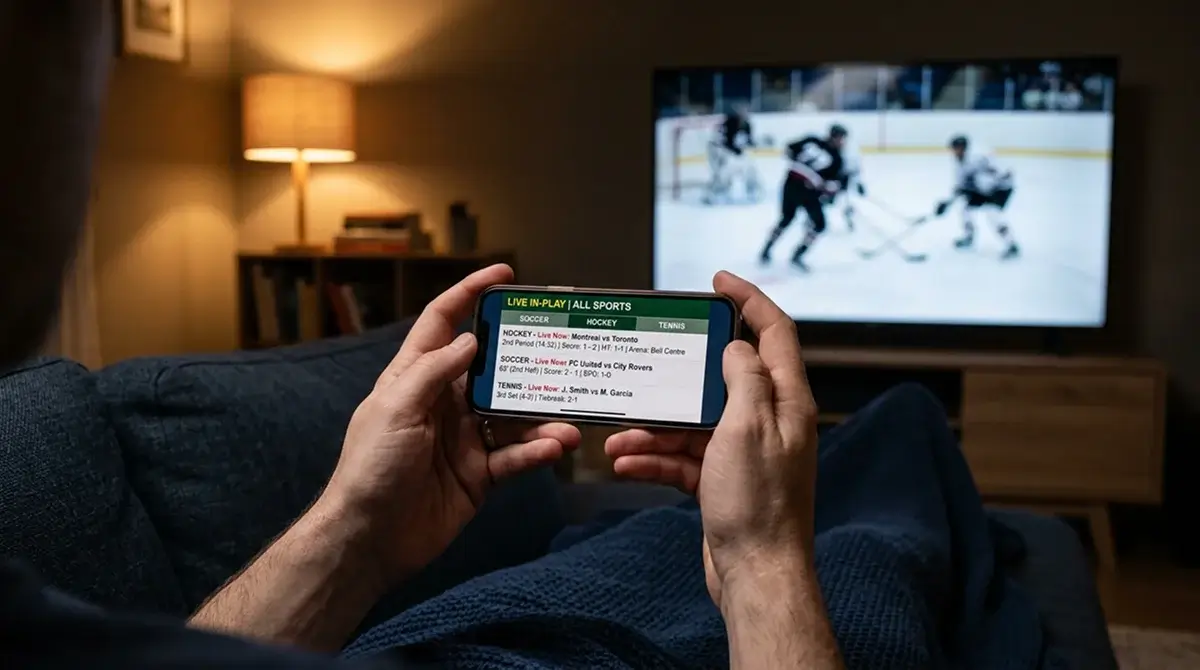
Live in-play wagering now drives more than sixty percent of regulated sports-betting volume in mature markets — a figure that has held steady across the 2025 US sample of $165.58 billion in handle, and a trend I see mirrored at UK books reporting their own splits. Hockey is one of the live-friendliest sports there is: short shifts, frequent stoppages, intermissions long enough to evaluate, and a price that moves on every shift, save and shot. Pre-match betting is the disciplined version. Live betting is the seductive one.
Pre-match prices have been shaped by professional money before they reach the UK punter. The line at 6 pm UK time on a 1 am NHL fixture is usually within touching distance of where it will close. Live prices, on the other hand, react instantly to events that may or may not be predictive — a fluke deflection, a goalie pulling early after a soft goal, a five-minute major. Those overreactions are where edge lives, but they are also where bankrolls bleed if you do not have a pre-built thesis about what the market is mispricing.
The simplest framing I give new punters: only place a live bet you would have placed pre-match at that same price. If the live line offers you the home team at 1.95 because they conceded an early shorthanded goal, and you were already thinking 1.80 was their fair price, the live market just handed you value. If the live line offers a price you would never have taken pre-match, you are chasing.
The latency point matters too. Live markets freeze briefly after every goal, sometimes for up to thirty seconds, and the freeze duration varies by sportsbook. A bet placed during the freeze is sometimes voided. A bet placed milliseconds before a goal you have just seen on a low-latency stream is usually voided too. The infrastructure is set up to protect the book, not the bettor, and you should plan accordingly.
The International Calendar That UK Books Quietly Price
The NHL and EIHL are the steady drumbeat. The international tournaments are the surge events — short, intense, betting-friendly windows that compress a normal season’s variance into ten to fourteen days. They also offer the deepest pricing inefficiency on the whole hockey calendar, because they only appear once a year and the books treat them accordingly.

The IIHF World Championship is the annual anchor. The 2025 edition, played in Stockholm and Herning across 9 to 25 May, drew 489,450 spectators across 64 matches — an average of 7,648 per game — and ended with the United States lifting their third world title. The 2024 edition in Czechia is the all-time attendance record at 797,727 spectators and 12,464 per match. The tournament is a round-robin into a single-elimination knockout, which is a pricing environment most UK punters never see in football and rarely see in any other sport.
Global hockey scale
More than 1.8 million registered ice hockey players in over 80 countries as of 2025. USA Hockey alone counts 640,000-plus registered players; Hockey Canada has 550,000-plus active members.
Great Britain’s place in the rankings
The GB men’s senior national team sits 17th in the IIHF world rankings, the women’s team 19th. Ice Hockey UK has been a member of the international federation since 19 November 1908 — among the longest unbroken memberships in the sport.
Other windows to watch
Olympic ice hockey when NHL players participate. The 4 Nations Face-Off. Champions Hockey League knockouts for European club action. World Junior Championship over the New Year week.
Why do these matter for a UK punter? Because the books open futures markets months ahead of the events, and the pricing inefficiency on long-tail outcomes is wider than anything you will find inside an NHL season. The trade-off is information access — covering ten national rosters with last-minute call-ups, injuries and goalie rotations is hard. But for the punter willing to do that work, international hockey is one of the highest-ROI windows on the calendar. The proper treatment, with format quirks and tournament-by-tournament pricing notes, sits in the international ice hockey tournament betting guide.
The Criteria That Actually Matter When You Pick Where to Bet
I get asked which UK sportsbook is “best” for hockey several times a week and I never answer the question that way. The right book depends on what you bet, how you bet, and how much you care about specific features. What I will tell you is the criteria the question should be filtered through — and they are not bonuses.

The non-negotiable layer is the licence. A UKGC licence means your funds are segregated, your disputes have a defined complaints path, your data is protected under UK law, and the sportsbook is bound by advertising and responsible-gambling codes. As of the financial year 2024/25 there were 5,825 licensed betting shops and 8,234 licensed gambling premises across Britain — the regulated infrastructure is substantial. The Betting and Gaming Council, the trade body for UK operators, has framed the industry’s value pointedly: “The betting and gaming industry is a hugely significant contributor to the leisure industry, to sport and to the UK economy as a whole.” That is true, and the regulation that comes with it is the protection a punter relies on.
Note — verifying a UKGC licence
Every UK-licensed operator must display their licence number and a link to the Gambling Commission register on their footer. Two clicks should take you from the bottom of any UK sportsbook home page to the public register entry confirming the licence is active. If those two clicks do not exist, neither does your protection.
Above the licence layer, the criteria that actually differentiate sportsbooks for hockey are pricing and market depth. Use a simple test: pull up the same NHL fixture across three or four UKGC-licensed sportsbooks and compare the moneyline, the puck line, and the totals. The difference between the best and worst price will be larger than any sign-up bonus over a typical betting year.
| Criterion | What to look for |
|---|---|
| Licence | UKGC licence number visible in footer, register entry active. |
| Hockey market depth | Full NHL menu including period markets, props and SGPs. EIHL coverage on top six markets at minimum. |
| Live betting infrastructure | Stable in-play product, transparent latency, clear voided-bet rules. |
| Payment and limits | Mainstream UK rails, configurable deposit limits, fast withdrawals. |
| Responsible-gambling tools | GAMSTOP integration, deposit/time/loss limits, reality checks, self-exclusion. |
| Customer-protection record | UKGC enforcement notices searchable; no recent material breaches. |
The point is structural. A bonus is a one-time decision. Pricing, market depth and protection are the recurring decisions you make every time you stake.
The Safer-Gambling Toolkit Every UK Hockey Punter Should Know
This is the section every UK punter scrolls past and the one every UK punter should actually read. I am going to be direct because the data is direct. The 18 to 24-year-old age band in Britain carries the highest concentration of problem-gambling indicators in the country — 21.9 percent score 1 or higher on the PGSI screen, 5.3 percent score 8 or higher. That is a public-health figure, not a marketing line.

The Gambling Commission’s chief executive Andrew Rhodes has framed the challenge with unusual urgency: “What I thought was a five-year-away problem, perhaps a year or two ago, I think is now an 18-month to two-year challenge.” Read that as the regulator’s signal that the rules and the tools are moving faster than they used to. The Betting and Gaming Council’s Michael Dugher has flagged a different concern, that pushing the regulated market too hard risks driving punters into unregulated channels: “I’m really worried that if we get the changes wrong here like they have in other countries in Europe, we will drive people into the black market. This means customers will be playing on websites that don’t have any of the safeguards or tools that the regulated market has.” Both points can be true at the same time, and both should sit with you when you set your own limits.
Warning — the niche-sport blind spot
Hockey betting in the UK happens at night, on mobile, often alone, after a long day. Every one of those factors raises behavioural risk above the baseline. The safer-gambling tools are not for “other people”; they are for the version of you who is awake at 2 am with three live NHL games open and a bankroll already down.
Do
- Set a monthly deposit limit before your first deposit of any new month.
- Use reality checks every 30 to 60 minutes during long live-betting sessions.
- Register with GAMSTOP if you have ever lost control of a session — the self-exclusion is binding across all UKGC-licensed sites.
- Track every bet, including the losers, in a single record.
- Take a planned break between the NHL regular season and playoffs to assess your year.
Don’t
- Treat a bonus as bankroll. It is a marketing tool, not yours.
- Chase losses by raising stakes mid-session to “get back to even”.
- Bet hockey at hours that disrupt your sleep more than once a week.
- Move to offshore sites because a UKGC book imposed a deposit limit that protects you.
- Ignore the language patterns — “just one more bet to break even” is the line every problem punter recognises in hindsight.
The named tools to know: GAMSTOP for cross-operator self-exclusion, GamCare for free counselling, BeGambleAware for awareness and signposting, and the Gambling Commission for regulatory complaints. Every UKGC-licensed sportsbook is required to expose these tools in-product, and using them does not mean you have a problem — it means you are running your bankroll like a professional. The professionals I know all use them.
The Hockey Year From a UK Punter’s Desk
Hockey is a long-season sport. The NHL alone serves 1,271 regular-season games, and the layered playoff bracket adds another 80-plus to the calendar, with combined playoff attendance topping 1.62 million spectators across the 2023/24 post-season. The EIHL adds 270 matches, plus Challenge Cup and playoff competition. The international tournaments slot on top. From late September to mid-June, there is rarely a week without meaningful hockey for a UK bettor.
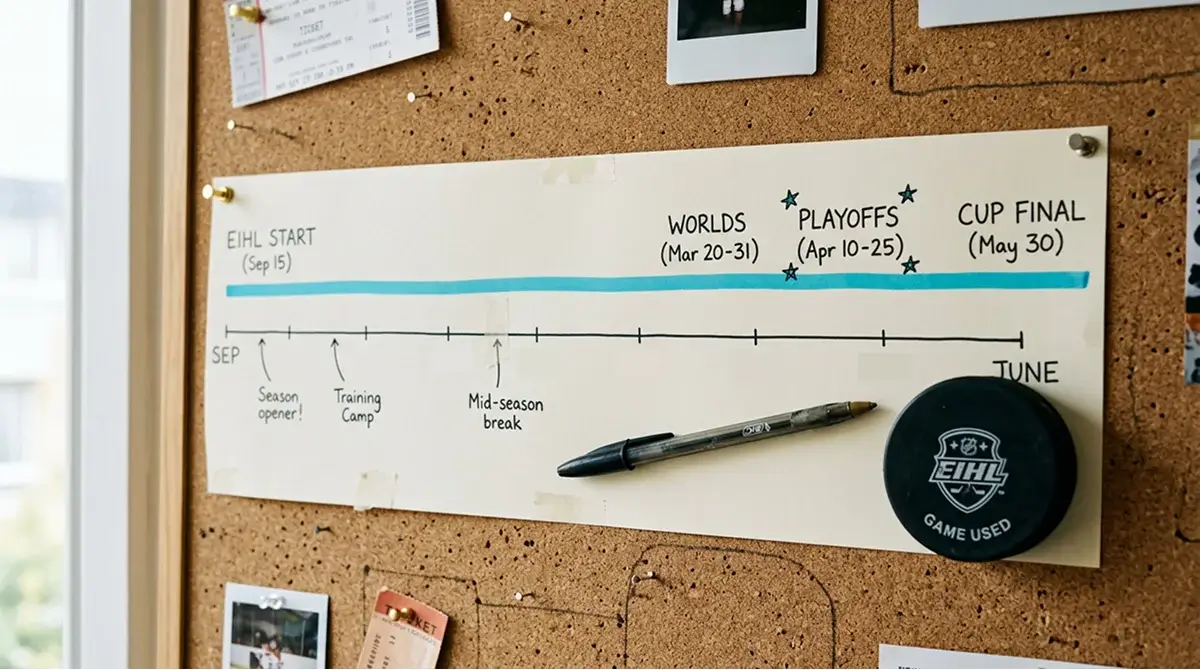
September
NHL pre-season fixtures. EIHL Premier Sports Challenge Cup group stage opens. Futures markets thicken.
October
NHL regular season tips off. First three to six weeks of EIHL league play. Goaltender sample sizes still noisy — bet narrow.
November–December
NHL settles into rhythm. EIHL Challenge Cup knockouts. World Junior Championship over Christmas/New Year.
January–February
NHL trade-deadline window opens. Conditional 4 Nations Face-Off or Olympic break depending on the cycle.
March
NHL regular season closes. EIHL playoff race tightens. IIHF Women’s Worlds early-month.
April
NHL playoffs begin. EIHL Playoff Finals Weekend, typically mid-month, often sold out.
May
NHL conference finals. IIHF Men’s Worlds — the deepest international futures market of the year.
June
Stanley Cup Final. Draft. Offseason futures open for the next NHL campaign.
Peak-volume nights
Saturday NHL nights — typically 12 to 14 games on the schedule — paired with the EIHL Saturday slate.
Quiet windows to watch
NHL All-Star break (mid-February) and the days between the Stanley Cup Final and free agency. Use these for review, not for forcing action.
UK-time advantage
EIHL Sunday afternoon fixtures land in UK prime time. NHL afternoon matinees on holidays land in UK evening time. Both are pricing windows worth knowing.
The point of mapping the year is rhythm. Markets are not equal across the calendar — opening-week NHL prices are noisier than late-March prices, IIHF futures move differently to in-tournament lines, EIHL playoff pricing reflects a smaller information environment than the regular season. A UK punter who treats the season as one undifferentiated stream will trade against bettors who know the rhythm and use it.
Where to Go From Here
Note from the desk
Nine years on this market has taught me one durable lesson: hockey rewards process and punishes narrative. The puck bounces, the goalie steals, the empty-netter swings the puck line at the buzzer — and across hundreds of bets, the punter with a written checklist, a tracked bankroll and a working sense of no-vig fair price will outpace the punter with a feel for the game and nothing else. None of that is exotic. All of it is repeatable.
The structure here mirrors how I actually work the market. The pillar gives you the frame. The cluster guides — NHL, EIHL, bet types, strategy, international — are where the practical work lives in detail. Start with the league you watch most. Build the checklist. Set the limits before the first bet, not after the first loss. Bet smaller than you think you should, longer than you think you need to, and on fewer markets than the menu invites. The edges are there. They are not where the promo banners say they are.
Hockey is a long game. So is hockey betting. See you at puck drop.
Frequently Asked Questions
Is it legal to bet on ice hockey in the UK?
Yes. UK adults aged 18 or over can bet on ice hockey through any sportsbook holding a UK Gambling Commission licence, whether the underlying league is the NHL, EIHL, an international tournament or a European pro league. Offshore sites without a UKGC licence are not illegal to use, but they sit outside UK consumer protections, GAMSTOP integration, deposit-limit standards and the UK regulator’s complaints route. The practical answer for any UK hockey punter is to stay inside the UKGC-licensed perimeter.
Which league is more popular with UK ice hockey bettors — NHL or EIHL?
Volume sits with the NHL. It offers 1,271 regular-season games against the EIHL’s 270, the markets are deeper, and live in-play volume from North America is the bigger contributor to UK hockey betting handle overall. The EIHL is rising fast — record attendance of 1,321,128 in 2025/26 and four straight seasons of growth — and now has a serious enthusiast following that bets it heavily on weekends. Most UK punters who take hockey seriously bet both, with NHL for nightly volume and EIHL for value pockets in a less efficient market.
What is the difference between puck line and moneyline?
The moneyline is the straight winner — whichever team wins after sixty minutes, overtime and the shootout takes the bet. The puck line is the hockey handicap, usually set at 1.5 goals. The favourite on the puck line must win by two or more goals to cash. The underdog on the puck line cashes if they lose by one or win outright. Because the handicap shifts the implied probability, the prices on each side move significantly relative to the moneyline — a heavy favourite at 1.40 on the moneyline might be priced around 2.10 on -1.5 puck line on the same fixture.
How does over/under (totals) work in ice hockey betting?
The book posts a number — most commonly 5.5 or 6.0 in the NHL — representing the predicted combined goal total. You bet whether the actual goal count will land above or below it. Half-point totals like 5.5 cannot push. Whole-number totals like 6.0 can push and refund stakes if the game ends with exactly that score. Empty-net goals and overtime goals all count towards the total under standard UK rules. The total is set by the operator’s modelling team and adjusted live based on early-game action.
Why does the starting goaltender matter so much in pricing a hockey market?
Because a single skater position absorbs roughly thirty shots a night and any single save is worth most of a goal in expected-value terms. Caesars’ head of hockey Karry Shreeve has cited a working estimate that swapping the starter typically moves implied probability on a moneyline by three to five percentage points — and added that “No player in hockey is worth too much more than 5 percent.” Goalie news moves prices faster than almost any other input. Confirmed starters tighten the market. Projected starters that turn out wrong open value the other way.
How do live (in-play) ice hockey markets behave compared with pre-match?
Live markets react to every shift, save and shot, with prices refreshing constantly and brief freezes after goals. Pre-match prices have been shaped by hours or days of professional money and tend to be sharper. Live markets are more reactive, more emotional in their movement, and consequently more prone to overreactions that disciplined bettors can fade. The trade-off is operational — live betting demands faster decision-making, tighter bankroll discipline, and a pre-built thesis about what the market is likely to misprice in-running. Live wagering accounts for more than 60 percent of regulated sports-betting volume in mature markets, which tells you both how popular it is and how much money flows through prices that move on incomplete information.
What responsible gambling tools are available to UK ice hockey bettors?
The core tools, all required of UKGC-licensed sportsbooks: deposit limits (daily, weekly, monthly), loss limits, time-out periods, reality checks during sessions, and full self-exclusion through GAMSTOP — which is binding across every UKGC-licensed online operator at once. Beyond the operators, GamCare offers free counselling and a 24-hour helpline, and BeGambleAware runs awareness and signposting resources. None of these tools require a “problem” diagnosis to use; setting deposit limits proactively before any session is standard bankroll hygiene for any serious bettor, and most professionals I know set them well below their disposable budget on principle.
Published by the ice Hockey Betting team.